Lying on stony ground the fragments
Kirche St. Gertrud, Cologne
August 27 - September 11, 2022










Relational Fields
Ulrike Jagla-Blankenburg on Madeleine Boschan’s Lying on Stony Ground the Fragments
St. Gertrud Church, Cologne, 2022
architecture by Gottfried Böhm 1963
How does a body find support and ground? Where does it locate itself in space? In what ways does one body relate to others? What are the consequences of movement and position?
What kinds of spaces do bodies disclose within space, and how do they transform what was once conceived as “archaic” space? Where and how do we come together?
These are questions that, today more than ever, extend toward the future. How will we orient ourselves as we move across thresholds into unknown territories, toward new spatial and social configurations? What possibilities emerge for human habitation?
Lying on stony ground the fragments—the title Madeleine Boschan chose for her exhibition at Sankt Gertrud, drawn from the song Strictly Confidential (1973) by Roxy Music—evokes the fragility and fluidity of time and space in our being-in-the-world.
The song speaks of “magical moments,” which likewise unfold in the course of moving through the exhibition. The visitor traverses an open field of imagination in which spatial, temporal, and kinetic relations become subjectively and physically perceptible—alongside fragile-monumental bodies whose claim to stability and support at first appears tentative, almost provisional.
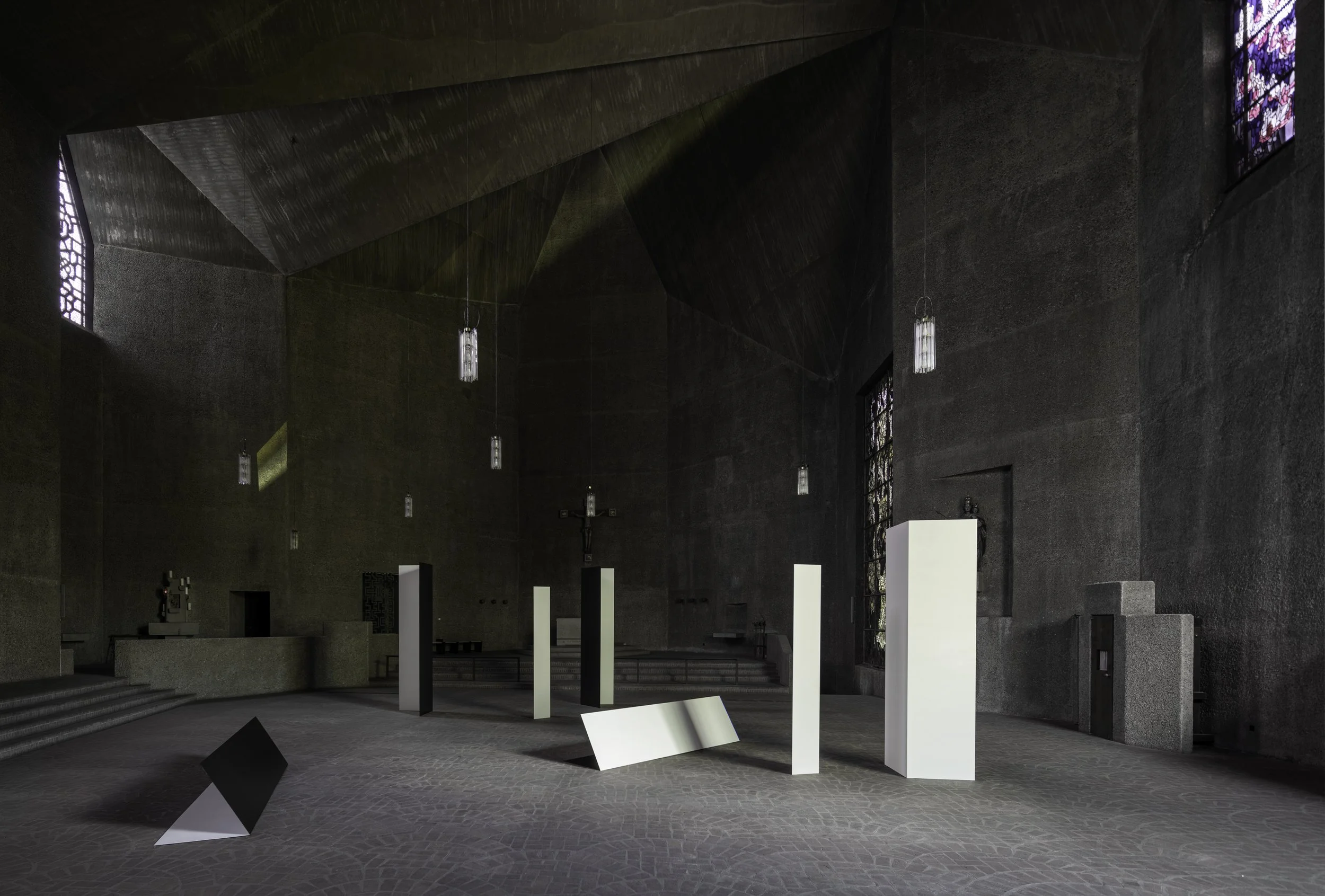
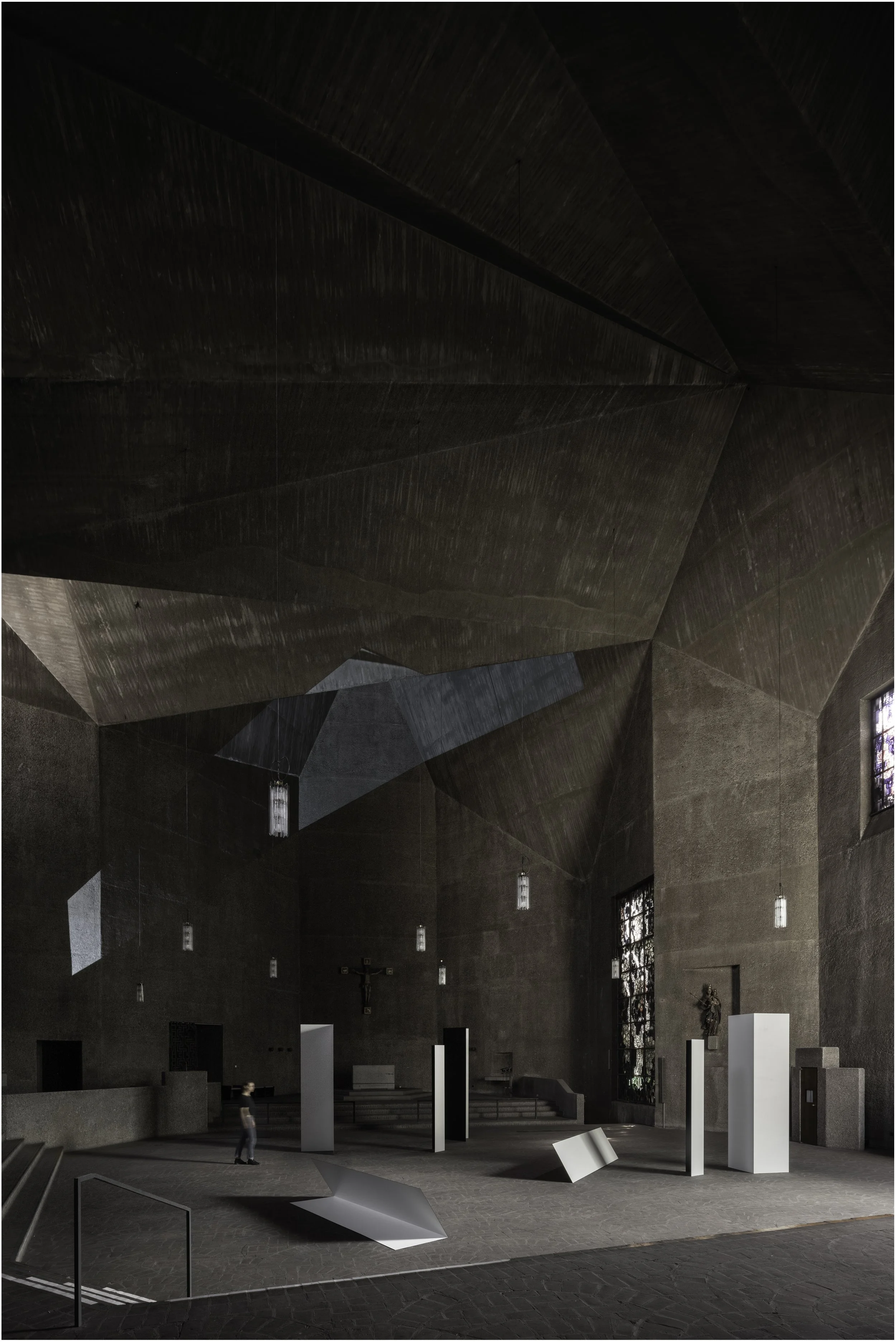
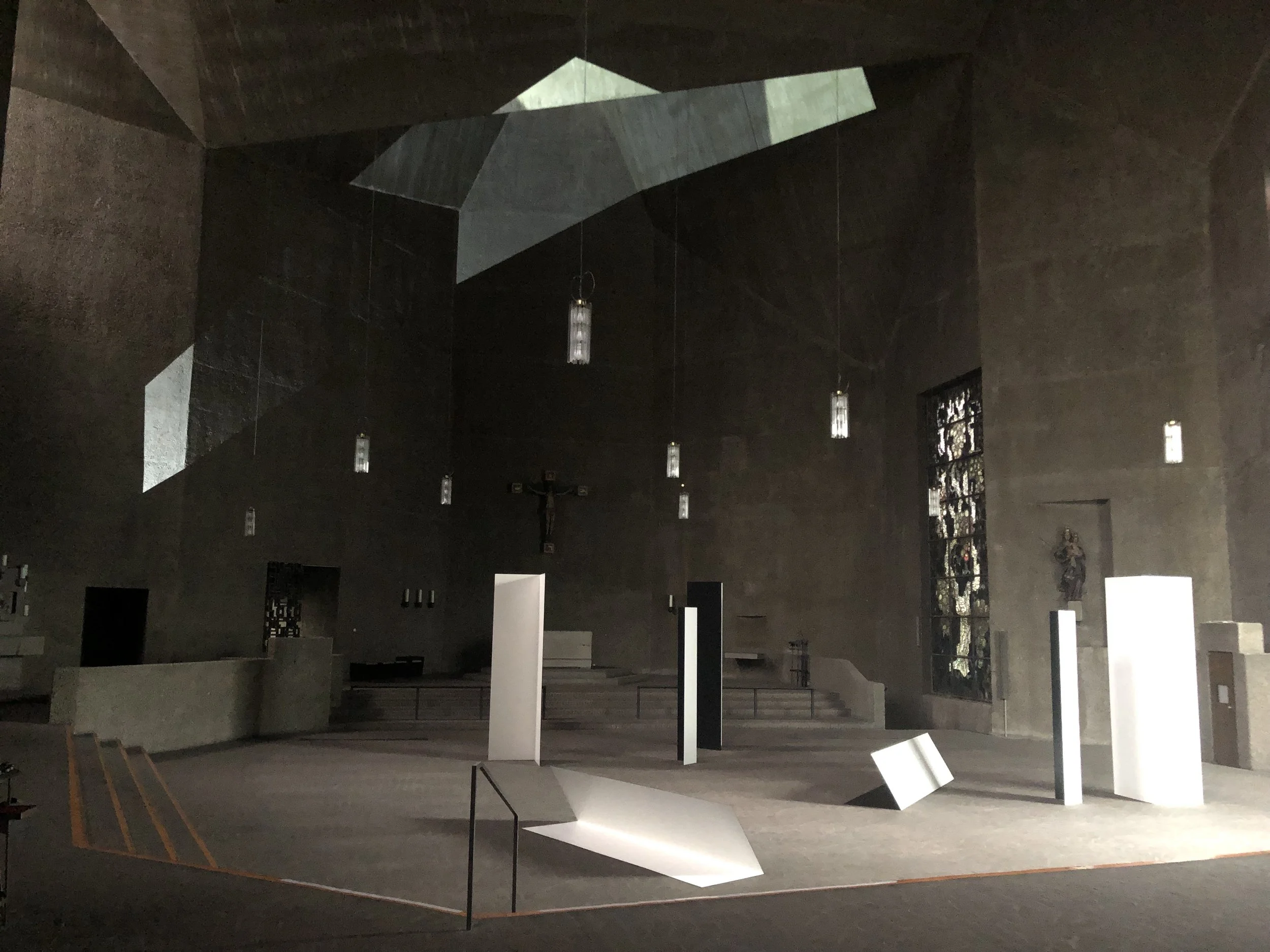
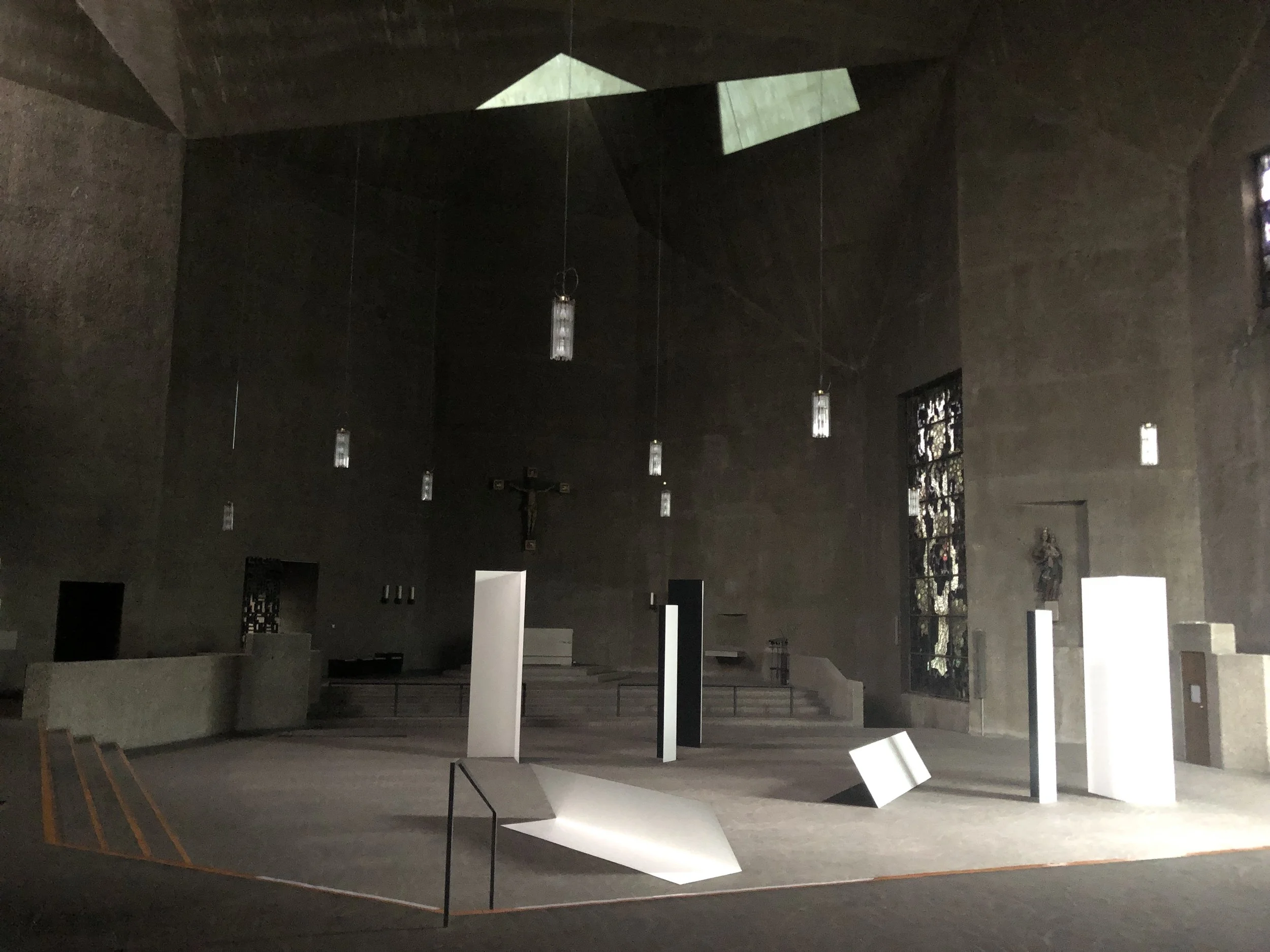
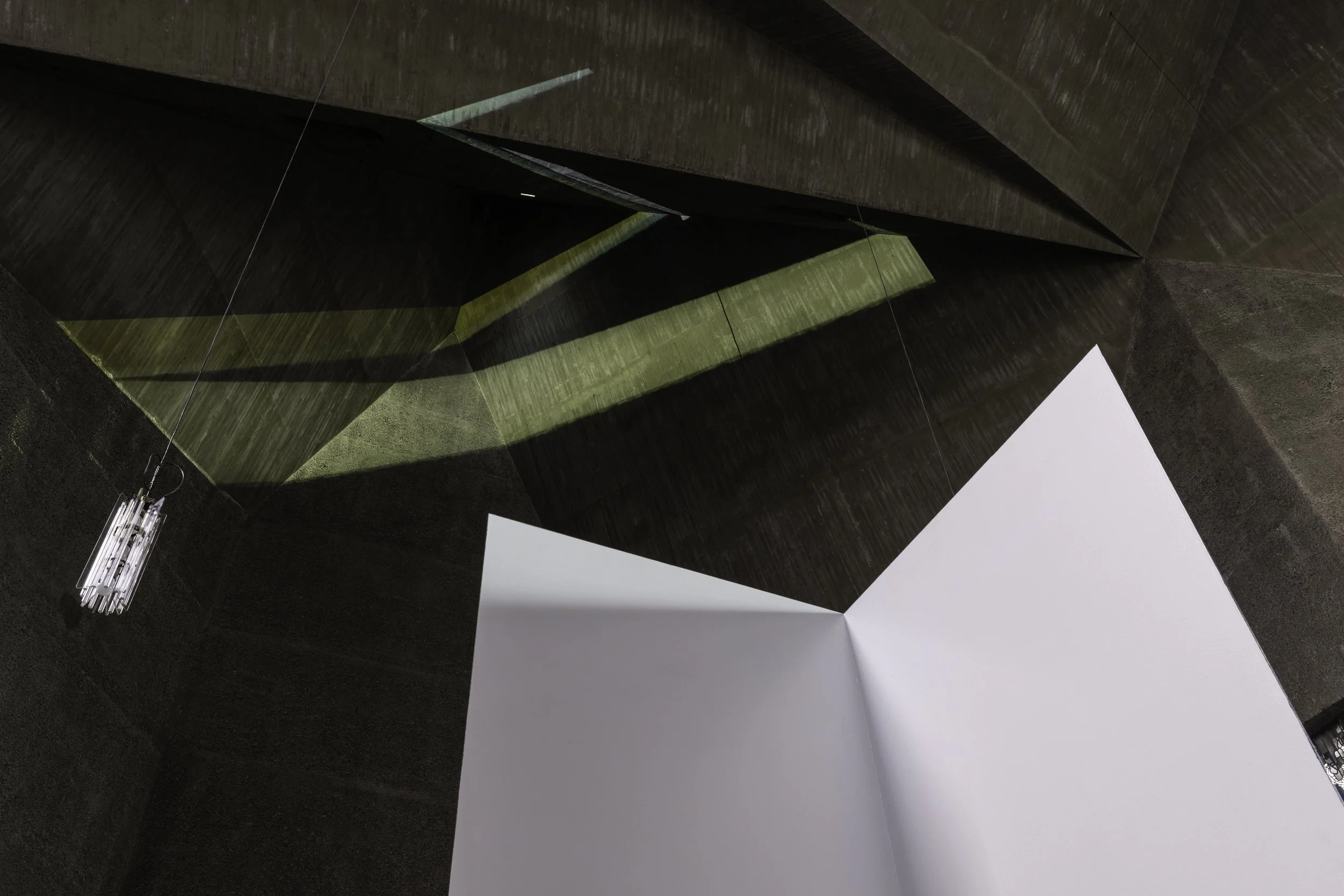
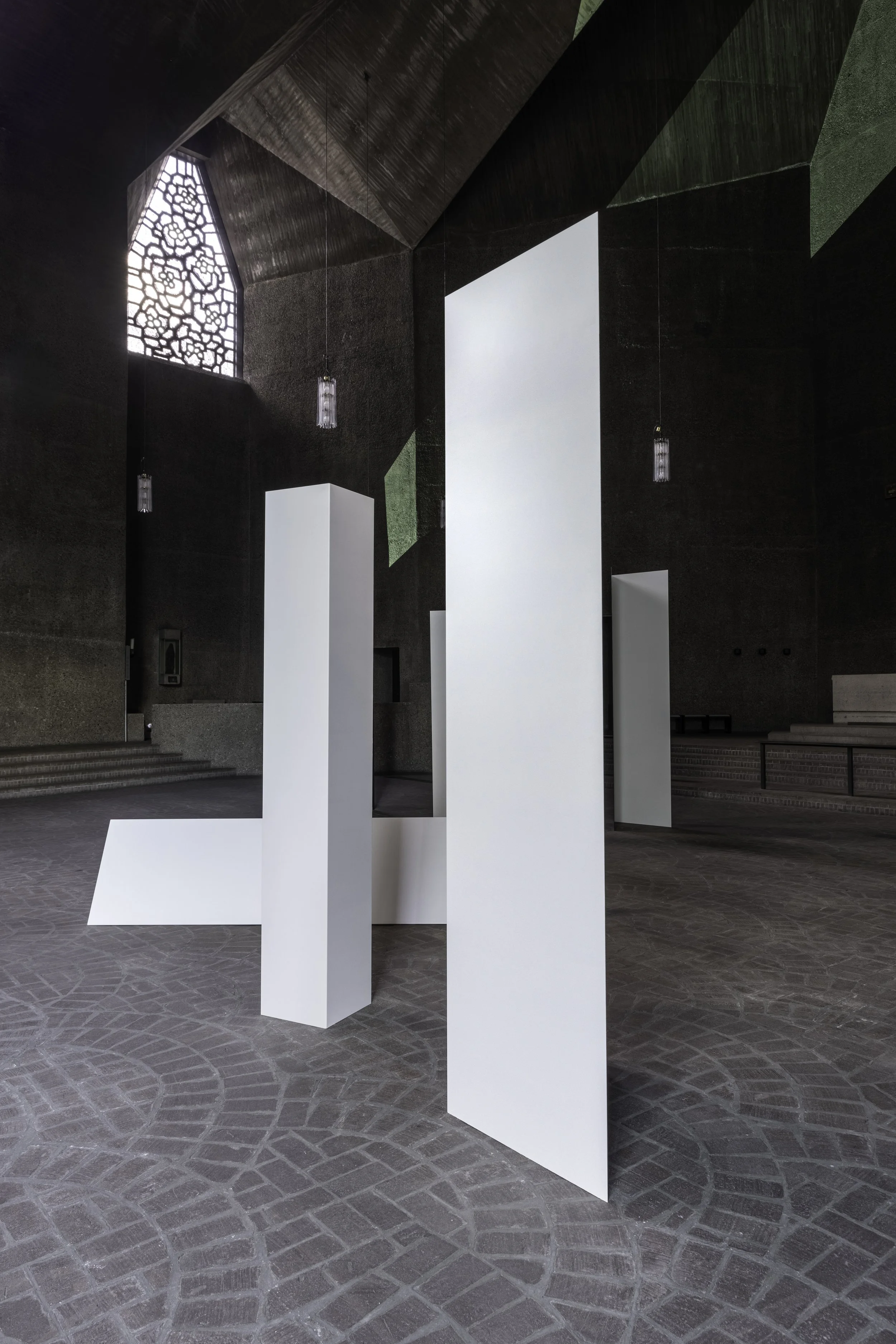
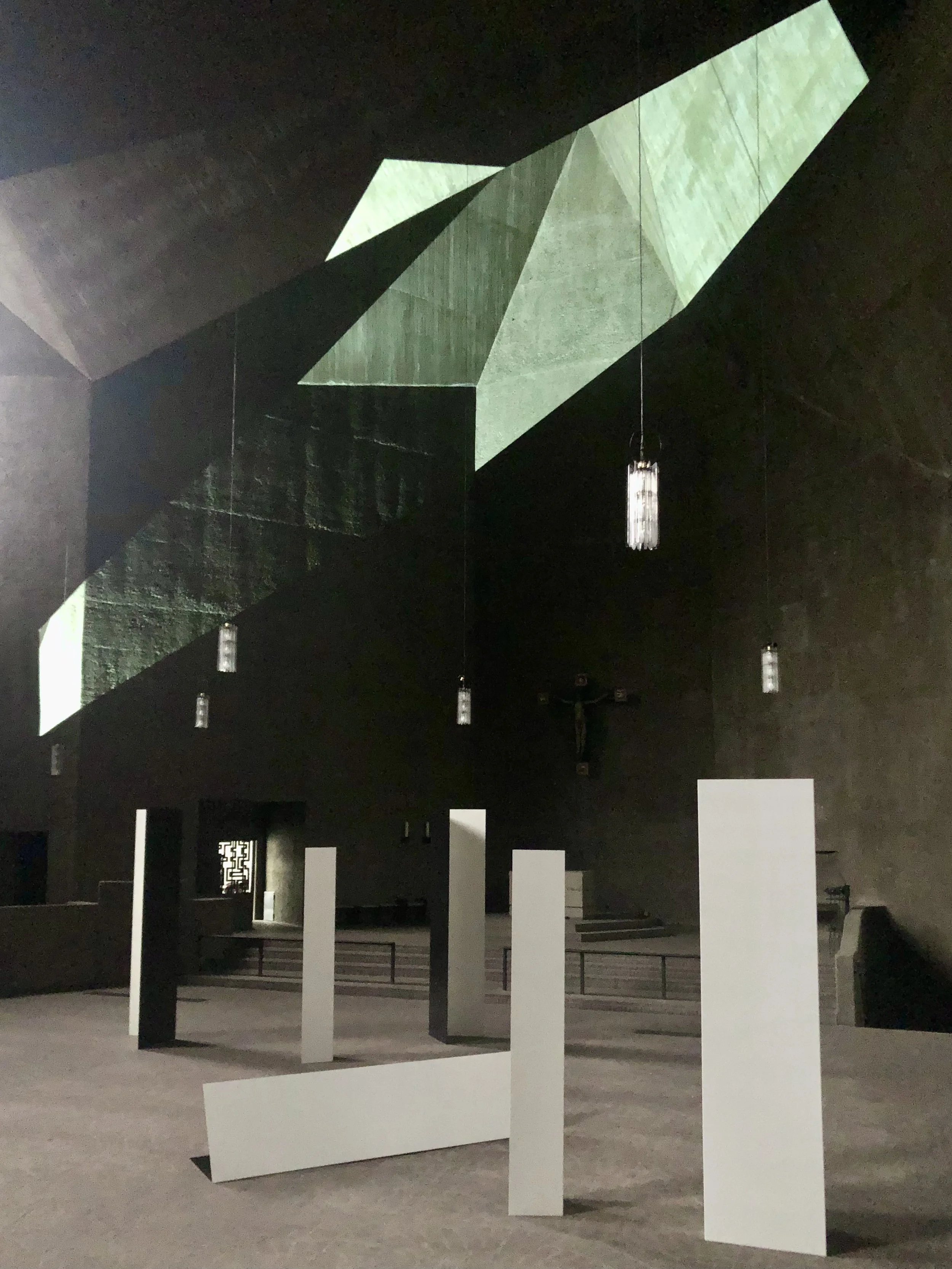
Madeleine Boschan’s sculptural installation responds to the interlocking, crystalline-organic structure of the Brutalist concrete architecture by Gottfried Böhm (1963), recipient of the Pritzker Architecture Prize, presenting upright and reclining aluminum elements arranged on the floor in 60- and 90-degree angles. In their interplay, these forms are not fixed but relational: they shift through their black and white surfaces and through the movement of the viewer, whose embodied perception activates and reconfigures them. What emerges is a topographically fluid field—less a stable arrangement than an initiated condition, open to contingency.
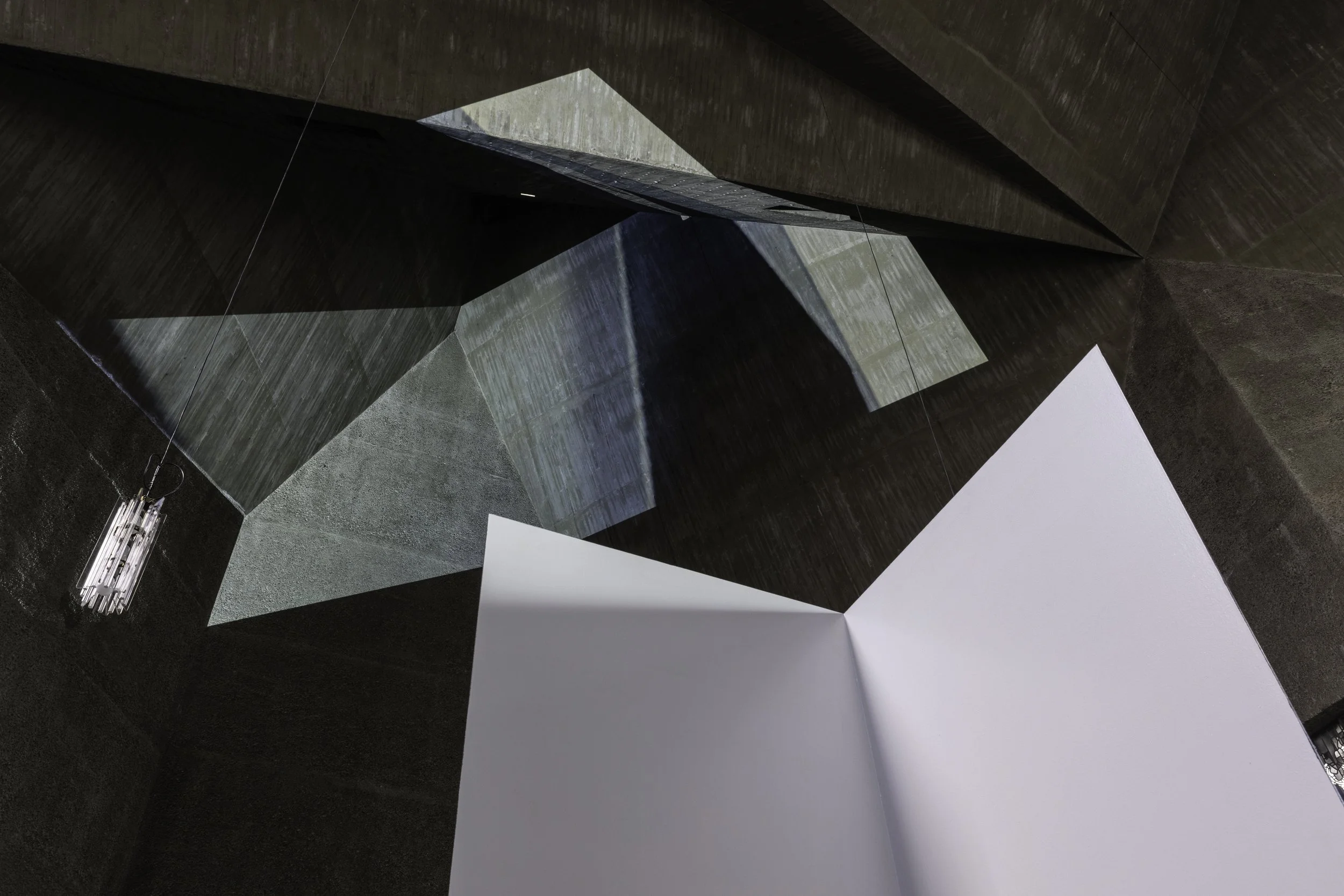
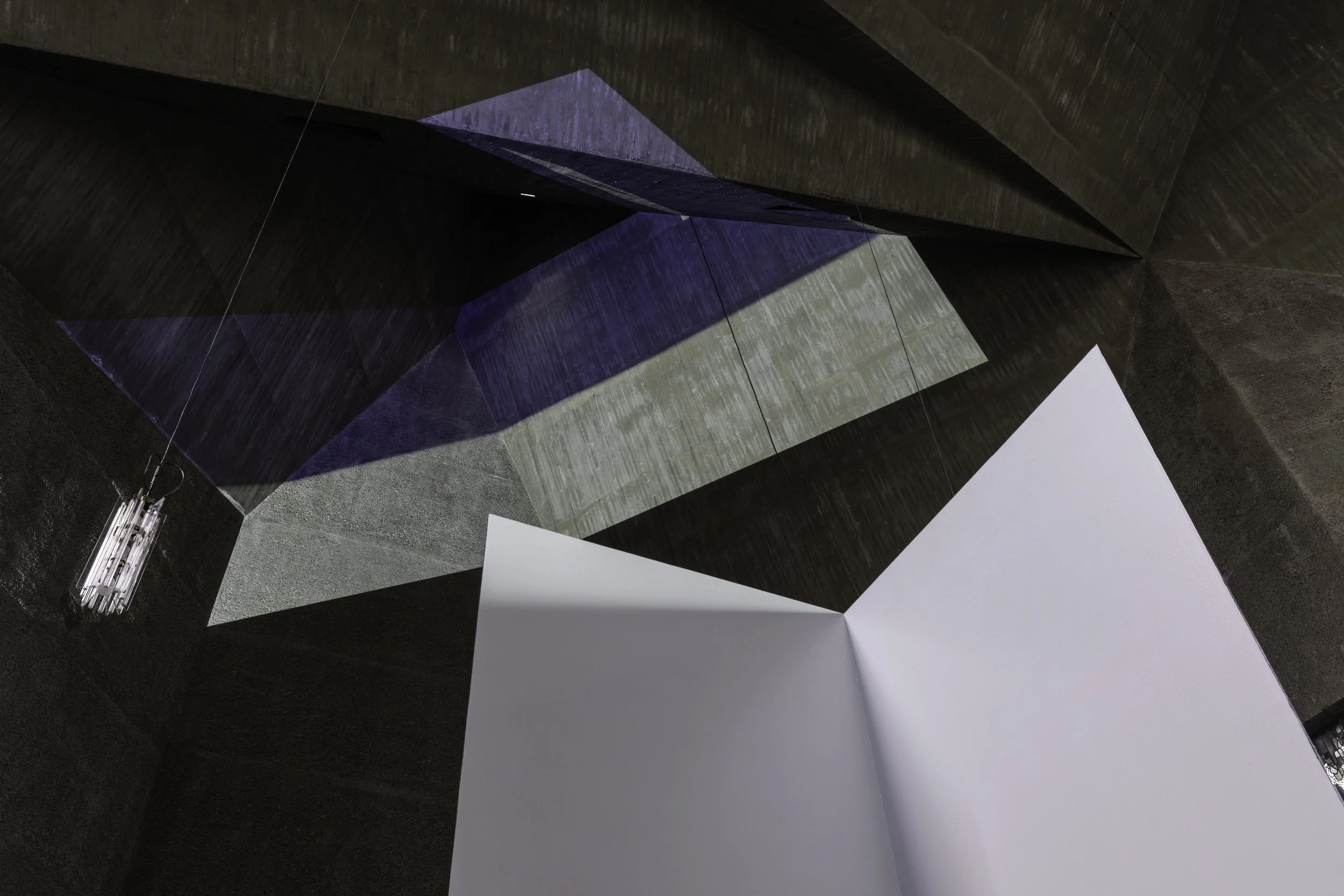
Boschan’s sculptures resonate not only with historical and sensorial references, but also with the interior of the church itself. The building rests on an angular ground plan that repeatedly advances and recedes, echoed in the complex geometry of the ceiling above. Within this formal constellation, sculpture and architecture converge in articulating a continuously shifting relation between interior and exterior, producing a multiplicity of experiential spaces that unfold only through movement.
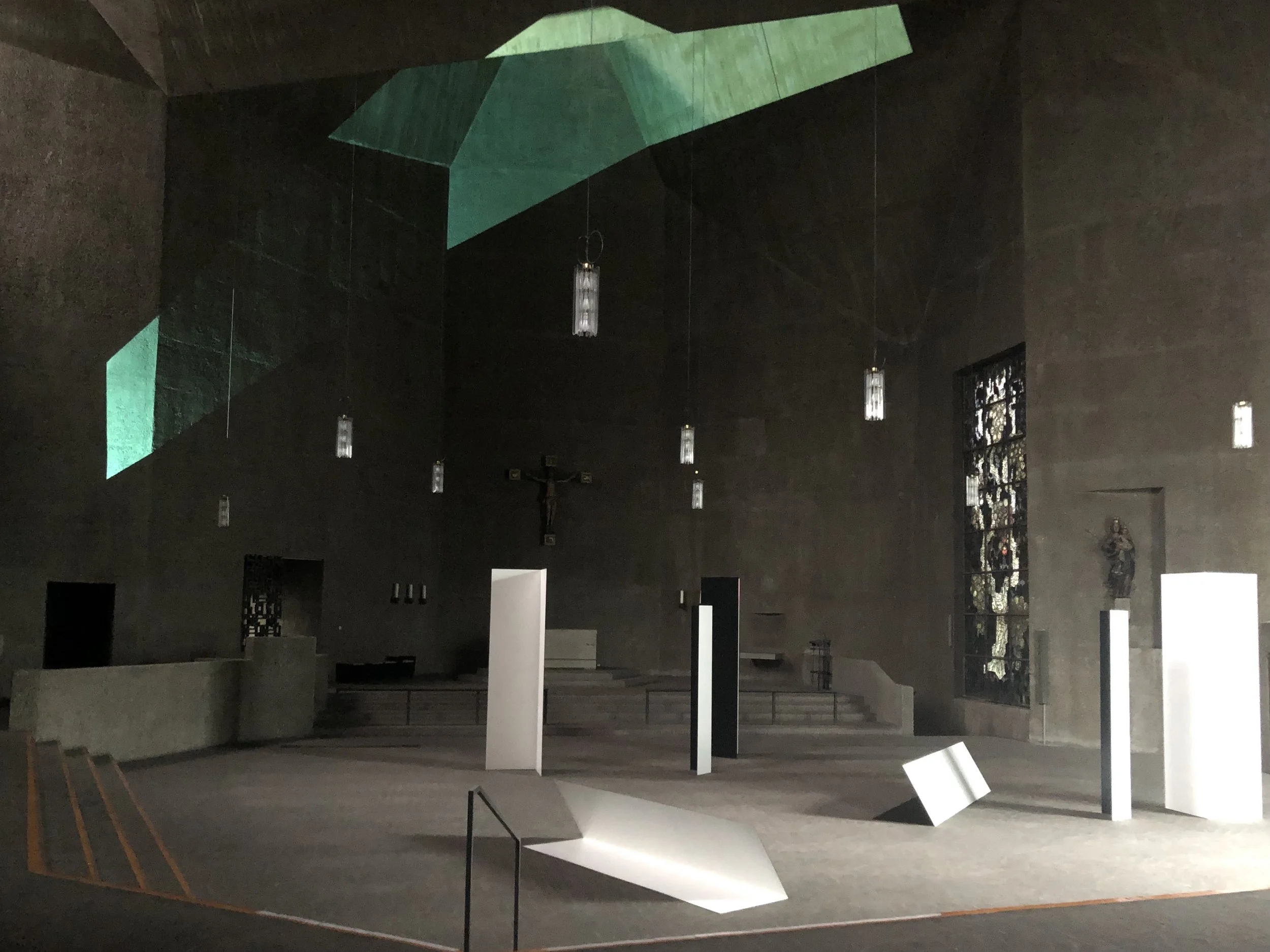
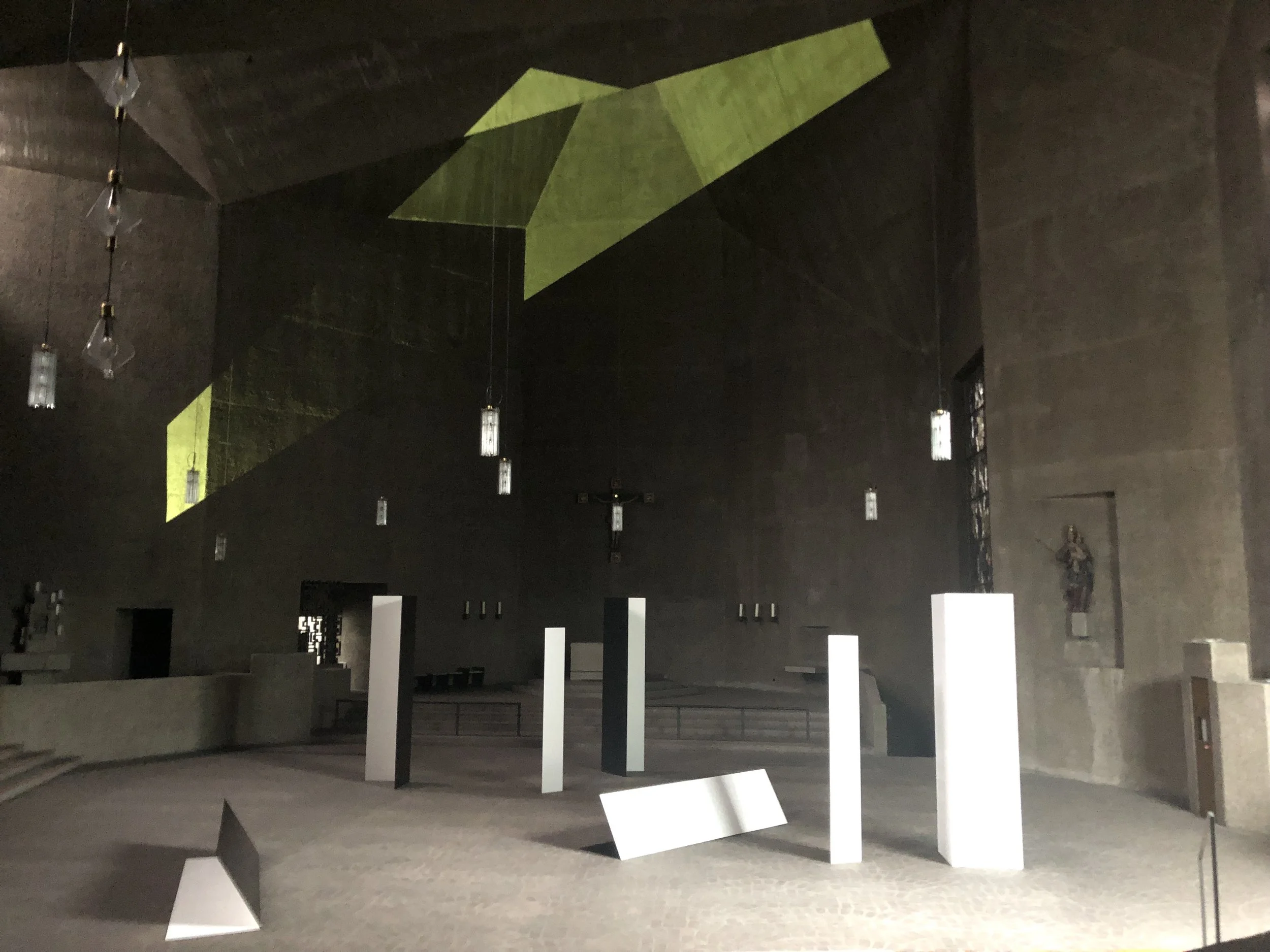
This dynamic is further extended by her film work, projected high into the ceiling, where it envelops the architectural structure and translates it into a temporal, flowing surface. Silently, shimmering colored blocks move in interlocking sequences, entering into a choreographic relation with the angular ceiling construction. Through their forward and backward motion, processes of correspondence emerge—between film and architecture, and between film and sculpture—oscillating between fusion and separation.
GERMAN VERSION
Wie findet ein Körper Halt und Stand? Wo verortet er sich im Raum? In welcher Weise tritt er in Beziehung zu anderen Körpern? Was sind die Konsequenzen von Bewegung und Position?
Welche Räume legen Körper im Raum frei, und wie verändern sie dabei einen einst als „archaisch“ gedachten Raum? Wo und wie kommen wir zusammen?
Dies sind Fragen, die sich heute mehr denn je in die Zukunft hinein stellen. Wie werden wir uns orientieren, wenn wir Schwellen überschreiten und uns in unbekannte Territorien, in neue räumliche und soziale Gefüge hineinbewegen? Welche Möglichkeiten eröffnen sich dabei für menschlichen Aufenthalt?
Lying on stony ground the fragments—der von Madeleine Boschan gewählte Titel ihrer Ausstellung in Sankt Gertrud, entnommen dem Song Strictly Confidential (1973) von Roxy Music—verweist auf die Fragilität und das Fließen von Zeit und Raum unseres In-der-Welt-Seins.
Der Song handelt von „magical moments“, die sich auch im Gang durch die Ausstellung einstellen. Der Besucher durchschreitet ein offenes Feld der Imagination, in dem räumliche, zeitliche und kinetische Relationen subjektiv wie physisch erfahrbar werden—entlang fragil-monumentaler Körper, deren Anspruch auf Halt und Stand zunächst zögerlich, beinahe provisorisch erscheint.
Die skulpturale Installation von Madeleine Boschan reagiert auf die verschachtelte, kristallin-organische Struktur der brutalistischen Betonarchitektur von Gottfried Böhm (1963), Träger des Pritzker Architecture Prize, und präsentiert stehende und liegende Elemente aus Aluminium, die in 60- und 90-Grad-Winkeln auf dem Boden angeordnet sind. In ihrem Zusammenspiel sind diese Formen nicht statisch, sondern relational: Sie verändern sich durch ihren schwarzen und weißen Anstrich ebenso wie durch die Bewegung des Betrachters, dessen verkörperte Wahrnehmung sie aktiviert und neu konfiguriert. Es entsteht ein topographisch fließendes Feld—weniger eine feste Anordnung als ein initiiertes Gefüge, offen für Unwägbarkeiten.
Boschans Skulpturen korrespondieren nicht nur mit historischen und sinnlichen Bezügen, sondern auch mit dem Innenraum der Kirche selbst. Der Bau basiert auf einer verwinkelten Grundfläche, die mehrfach vor- und zurückspringt, sowie auf der komplexen Geometrie der hoch gelegenen Decke. In dieser formalen Konstellation verschränken sich Skulptur und Architektur in der Artikulation eines sich ständig verschiebenden Verhältnisses von Innen und Außen und erzeugen eine Vielzahl von Erfahrungsräumen, die sich erst in der Bewegung erschließen.
Diese Dynamik wird durch die Filmarbeit, hoch in die Decke projiziert, weitergeführt. Sie ummantelt die architektonische Struktur und überführt sie in eine zeitliche, fließende Oberfläche. Lautlos bewegen sich farbig flirrende Blöcke in verschachtelten Abläufen und treten in eine choreografische Beziehung zur verwinkelten Deckenkonstruktion. In ihren Vor- und Rückwärtsbewegungen entstehen Korrespondenzen zwischen Film und Architektur sowie zwischen Film und Skulptur—Prozesse, die zwischen Verschmelzung und Ablösung oszillieren.
photos / Fotos by Stephan Klonk